
Many industrial OEM customers require IP67‑rated membrane switches for weighing scales, agricultural machinery, emergency lighting and outdoor control panels. But what does real‑world IP67 testing look like inside a membrane‑switch manufacturing plant?
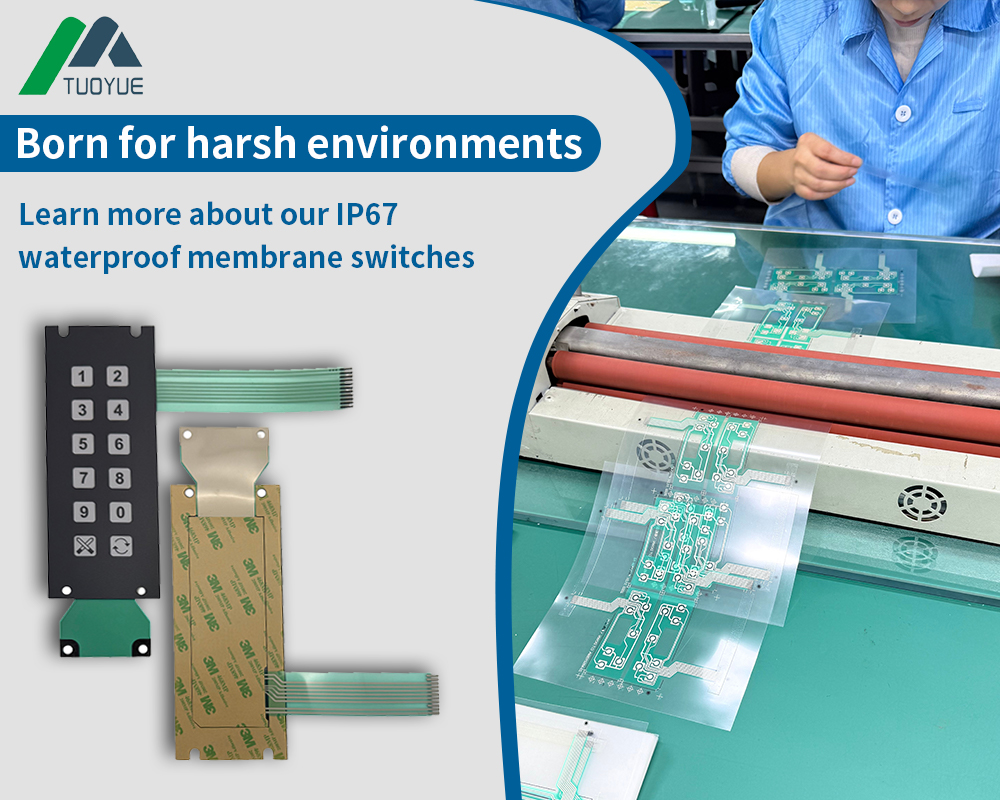
At Tuoyue, we perform full IP67 validation in‑house. You can watch our actual factory waterproof immersion test via our Facebook Reel: https://www.facebook.com/reel/1956175395293051
This video shows our complete submersion test procedure for finished membrane‑switch samples.
What is IP67 for Membrane Switches (IEC 60529 Standard)
IP67 means two levels of protection:
Digit‑6: Dust‑tight, zero harmful dust ingress.
Digit‑7: Protected against temporary immersion: the unit sits under 1‑meter fresh water for 30 minutes at room temperature, with no water penetration that causes electrical failure.
Important note: IP67 temporary‑immersion rating does not automatically equal IP65 water‑jet resistance. If your equipment faces high‑pressure washing, dual‑rating IP65/IP67 must be specified and tested separately.
Our In‑House IP67 Test Workflow at Tuoyue Factory
Before submersion, every test sample is built exactly as mass‑production units, including perimeter sealing, 3M industrial adhesive, sealed FFC tail exit and display‑window bonding. We avoid testing poorly‑assembled prototypes that cannot reflect real‑world performance.
Pre‑immersion functional baseline test
We run full electrical checks: continuity, contact resistance and tactile dome feedback. We record baseline performance to compare after testing.
Static water immersion (IPX7 phase)
The complete membrane‑switch assembly is fully submerged, with its highest point kept at least 150 mm below the water surface for a continuous 30‑minute cycle, following IEC‑60529 requirements. Our Facebook Reel captures this submersion step.
Drain & surface drying
After 30 minutes, we lift samples out of the water and wipe off all external surface moisture. We do not open the laminate immediately, allowing residual surface water to evaporate.
Post‑test inspection & electrical re‑validation
Visual check: zero water trapped between internal layers, no wicking along FFC tail exit or display‑window edges.
Electrical retest: verify contact resistance, switch actuation and signal stability match pre‑test baseline.
Pass criteria: no short‑circuit, no intermittent key failure, no trace of internal moisture.
If any water ingress is found, the sample fails IP67 testing. Our engineering team analyzes leak points: perimeter adhesive gaps, tail‑exit sealing defects or window‑bonding weaknesses, and optimizes drawings before next sampling.
Most Common IP67 Failure Points for Membrane Switches
From thousands of our custom HMI projects, three locations cause nearly all immersion test failures:
FFC / flexible tail exit: Water wicks along flexible circuit edges under hydrostatic pressure. We apply potting or reinforced adhesive sealing for IP67‑grade units.
Perimeter adhesive band: Insufficient adhesive width or uneven lamination creates micro‑gaps for water intrusion. We use minimum 7‑10 mm sealing perimeter for IP67 designs.
LCD / LED display windows: Poor bonding around transparent cut‑outs becomes hidden leakage channels.
Critical reminder: Even a membrane switch that passes standalone IP67 testing can lose waterproof performance once mounted onto poorly‑flat customer housing. We advise OEM partners to check housing surface flatness during DFM review stage.
Beyond IP67: Additional Environmental Validation
For harsh‑environment projects, we combine IP67 immersion with supplementary reliability tests: salt‑spray corrosion test, high‑low temperature cycling and 1‑million‑cycle tactile‑dome lifespan testing.
FAQ
Q: Can IP67 membrane switches survive high‑pressure water jet cleaning?
A: Not automatically. IP67 certifies temporary immersion, not high‑pressure jet wash‑down. Specify IP65/IP67 dual rating if jet‑spray cleaning is required.
Q: Will IP67 rating remain after I install your membrane switch to my plastic housing?
A: Membrane‑switch IP performance depends partly on your housing flatness and mounting gasket. We review housing drawings during DFM to minimize installation‑related sealing risk.
Q: Do you provide IP test reports for custom membrane‑switch orders?
A: Yes. We supply test documentation for IP‑rated prototypes and production batches upon customer request.
Get Your IP‑Rated Membrane‑Switch Solution
If you need custom IP67 / IP68 membrane keypads for industrial, medical, weighing‑scale or agricultural equipment, send your CAD drawings and environmental‑specification requirements. Our engineering team will review your design and offer DFM sealing suggestions.