
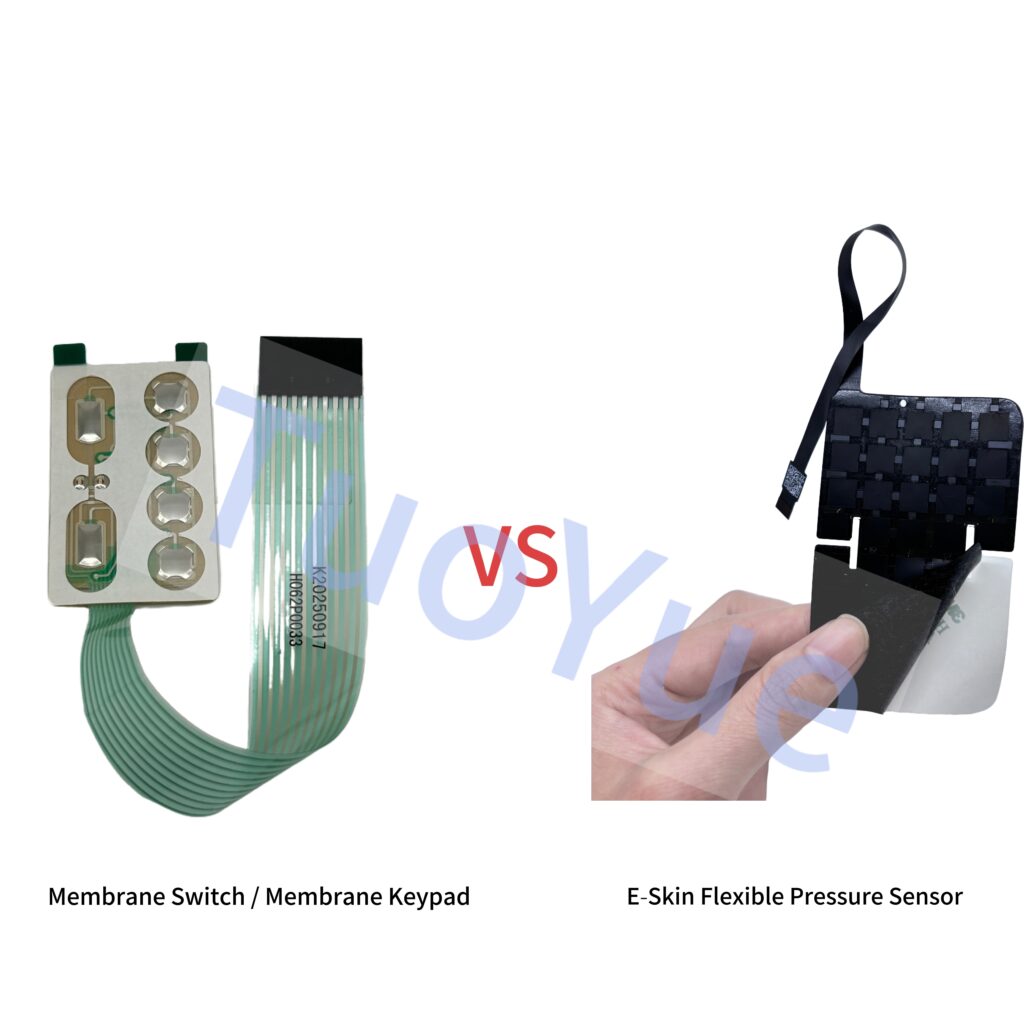
Engineers working on flexible electronics often mix‑up membrane switches and E‑skin (electronic‑skin) flexible pressure sensors. Both adopt thin flexible PET/FPC substrates and printed conductive traces, but their core functions, signal outputs and end‑use scenarios are completely different. Mis‑selection will lead to extra engineering cost and product failure.
What is a Membrane Switch
A membrane switch is a classic human‑machine interface component. It delivers binary on‑off switch signals: pressing closes the circuit; releasing opens the circuit.
Most designs use metal snap domes to provide tactile feedback. It only detects whether a button is pressed or not, cannot measure how hard you press. It connects directly to simple IO ports of mainboard without complex signal processing.
Main applications: industrial control panels, medical device keypads, emergency‑light HMI, POS terminals, agricultural‑machine operator interfaces.
What Is E‑Skin / Flexible Pressure Sensor
E‑skin (electronic skin) is a bionic flexible sensing system. It consists of dense pressure‑sensing pixel arrays built on flexible substrates (PET, PU, silicone).
Instead of simple on‑off signals, it outputs continuous analog values. It can measure pressure magnitude, pressure distribution, deformation and impact force, generating pressure‑mapping data for upper‑level algorithms.
Common working principles include piezoresistive, capacitive and piezoelectric mechanisms. It requires dedicated acquisition hardware and algorithm processing to convert raw sensor data into usable information.
Main applications: robot tactile skin, smart in‑sole foot‑pressure monitoring, rehabilitation medical wearables, automotive seat‑pressure detection, fixture clamping‑force testing.
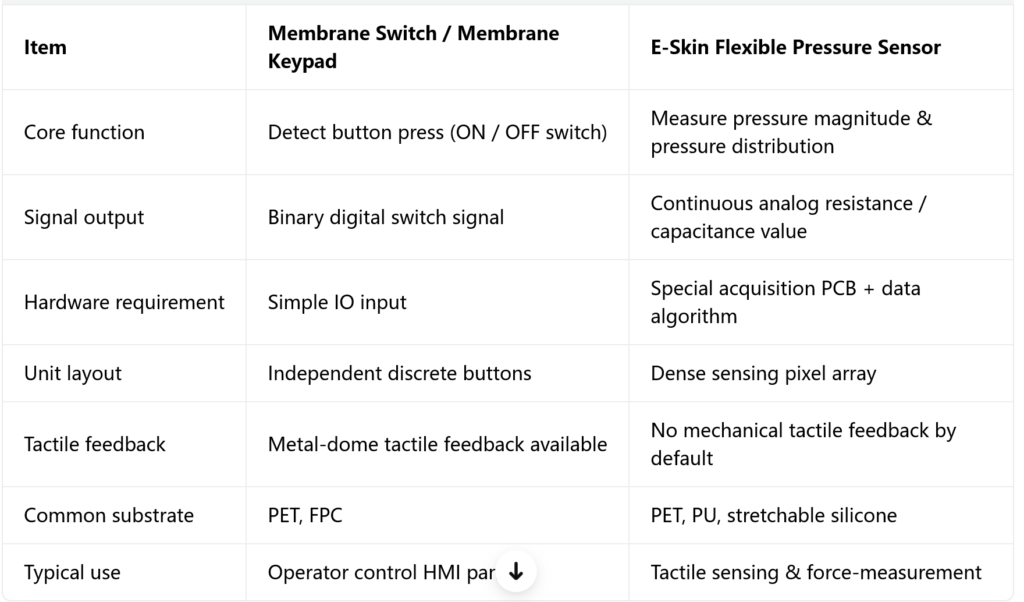
Side‑by‑Side Comparison Table
Our Manufacturing Capability For Flexible‑Circuit Projects
At Tuoyue, we are well‑known for custom membrane‑switch and silicone‑keypad manufacturing. For E‑skin and flexible‑pressure‑sensor projects, we provide custom‑fabrication for flexible printed‑circuit substrates.
We can produce silver‑ink printed PET circuits, FPC copper‑etched traces, reinforced FFC tail outlets, sealing lamination and overlay assembly for your sensing projects.
Note: We do not develop or supply the pressure‑sensitive functional material layer or sensor‑processing firmware. We work as your reliable flexible‑circuit manufacturing partner.
FAQ
Q: Can capacitive membrane switches replace E‑skin flexible pressure sensors?
A: No. A capacitive membrane switch only judges touch presence. It cannot quantify pressure strength or generate multi‑point pressure‑distribution maps.
Q: Do flexible pressure‑sensor arrays work like standard membrane keypads?
A: Not natively. Even if you map sensor pixels as virtual buttons, you still need extra signal‑processing hardware, which increases BOM cost. Choose membrane switches for ordinary operator‑panel requirements.
Q: Can Tuoyue manufacture circuit layers for my e‑skin prototype?
A: Yes. Send your CAD files and mechanical specifications, our engineering team will review your flexible‑circuit requirements and provide DFM suggestions.
Final Thought
Choose membrane switches if you need reliable operator control keypads. Choose E‑skin flexible pressure sensors only when your product needs force‑measurement or pressure‑mapping functions.
If you need custom‑built membrane‑switch HMI panels or flexible printed‑circuit substrates for your sensing prototype, send your drawings for a technical review and quotation.